
The Right to See with Technology
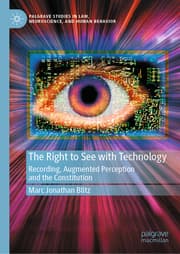
eBook - Recording, Augmented Perception, and the Constitution, Behavioral Science and Psychology (R0)
€50.95
(inklusive MwSt.)
Verfügbarkeit: Lieferbar
Zusatztext
<p class="MsoNormal" style="mso-margin-top-alt: auto; mso-margin-bottom-alt: auto; text-align: justify; line-height: normal;"><span style="mso-fareast-font-family: 'Times New Roman'; mso-bidi-font-family: Calibri; mso-bidi-theme-font: minor-latin; mso-fareast-language: EN-IN;">This book asks if we have a constitutional right to see or sense our surroundings with technology.<span style="mso-spacerun: yes;"> </span>Do we have a constitutional right to record our surroundings with cameras embedded in smartphones or drones?<span style="mso-spacerun: yes;"> </span>Or to enhance our vision with extended reality technology, bionic eyes, or brain-computer interfaces? Courts in the United States have already provided a possible foundation for answering such questions.<span style="mso-spacerun: yes;"> </span>There is, they have said, a right to document matters of public concern by creating and sharing recordings with others.<span style="mso-spacerun: yes;"> </span>Such recordings extend our perception: They let us watch events that are remote in space and time.<span style="mso-spacerun: yes;"> </span>Yet sharing them is also a kind of communication and thus, the creation of “speech” protected by the First Amendment.<span style="mso-spacerun: yes;"> </span>So too might be other ways of seeing with technology. This emerging case law raises interesting questions and challenges, such as how enhancement of our perceptions can leave room for others’ privacy.</span></p> <p class="MsoNormal" style="mso-margin-top-alt: auto; mso-margin-bottom-alt: auto; text-align: justify; line-height: normal;"><span style="mso-fareast-font-family: 'Times New Roman'; mso-bidi-font-family: Calibri; mso-bidi-theme-font: minor-latin; mso-fareast-language: EN-IN;">This book explores such questions, focusing on American constitutional jurisprudence. It also argues that, in doing so, it is helpful to recognize that our interest in using and enhancing our perceptual power isn’t only an interest in doing so as part of First Amendment communication.<span style="mso-spacerun: yes;"> </span>It is also linked closely to other rights - to personal integrity and the liberty to use our body’s perceptual powers and to the constitution’s protection for freedom of thought or what some scholars call “cognitive liberty:” Our exercise of perception and our use of it to learn about our surroundings is a crucial part of exercising our and shaping our mind. </span></p>
Autorenportrait
<p class="MsoNormal" style="text-align: justify;"><span style="mso-bidi-font-family: Calibri; mso-bidi-theme-font: minor-latin; mso-bidi-font-weight: bold;"><strong>Marc Jonathan Blitz</strong> is Alan Joseph Bennett Professor of Law at Oklahoma City University, USA. His scholarship focuses on how new technologies related to surveillance, extended reality, and neuroscience raise questions about privacy and freedom of thought and speech.</span></p>
Weitere Details
Erschienen: 31.07.2025
Umfang: 4.96 MB
Sprache: ENG
ISBN/EAN: 9783031895333
Umbreit-Nr.: 7268620
