
An Introduction to the Theory of Observational Studies
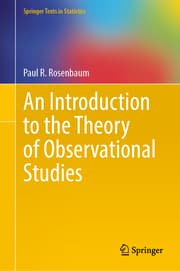
eBook - Mathematics and Statistics (R0)
€111.95
(inklusive MwSt.)
Verfügbarkeit: Lieferbar
Zusatztext
<p class="MsoNormal"><span lang="EN-US">This book is an <em>introduction</em> to the <em>theory</em> of causal inference in observational studies.<span style="mso-spacerun: yes;"> </span>An observational study draws inferences about the effects caused by treatments or preventable exposures when randomized experimentation is unethical or infeasible.<span style="mso-spacerun: yes;"> </span>An observational study is distinguished from an experiment by the problems that follow from the absence of randomized assignment of individuals to treatments.<span style="mso-spacerun: yes;"> </span>Observational studies are common in most fields that study the effects of treatments or policies on people, including public health and epidemiology, economics and public policy, medicine and clinical psychology, and criminology and empirical legal studies.<span style="mso-spacerun: yes;"> </span></span></p> <p class="MsoNormal"><span lang="EN-US">After Part I reviews causal inference in randomized experiments, the twelve short chapters in Parts II, III and IV introduce modern topics: the propensity score, ignorable treatment assignment, the principal unobserved covariate, algorithms for optimal matching, randomized reassignment techniques for appraising the covariate balance achieved by matching, covariance adjustment, sensitivity analysis, design sensitivity, ways to design an observational study to be insensitive to larger unmeasured biases, the large sample efficiency of a sensitivity analysis, quasi-experimental devices that provide observable information about unmeasured biases, evidence factors and complementary analyses to address unmeasured biases.</span></p> <p class="MsoNormal"><span lang="EN-US">The book is accessible to anyone who has completed an undergraduate course in mathematical statistics.<span style="mso-spacerun: yes;"> </span>The subject is developed with the aid of two simple empirical examples concerning the health benefits or harms caused by consuming alcohol.<span style="mso-spacerun: yes;"> </span>The data for these examples and their reanalyses are freely available in an R package, iTOS, associated with <em>Introduction to the Theory of Observational Studies</em>.</span></p>
Autorenportrait
<p><span lang="EN-US" style="font-size: 11.0pt; line-height: 107%; font-family: 'Aptos',sans-serif; mso-ascii-theme-font: minor-latin; mso-fareast-font-family: Aptos; mso-fareast-theme-font: minor-latin; mso-hansi-theme-font: minor-latin; mso-bidi-font-family: 'Times New Roman'; mso-bidi-theme-font: minor-bidi; mso-ansi-language: EN-US; mso-fareast-language: EN-US; mso-bidi-language: AR-SA;">Paul R. Rosenbaum is the Robert G. Putzel Professor Emeritus in the Department of Statistics and Data Science at the Wharton School of the University of Pennsylvania. He is the author of several books, including Observational Studies (1st edition 1995, 2nd edition 2002), Design of Observational Studies (1st edition 2010, 2nd edition 2020), Observation and Experiment: An Introduction to Causal Inference (2017), and Replication and Evidence Factors in Observational Studies (2021). <span style="mso-spacerun: yes;"> </span>In joint work, he and Donald B. Rubin invented the propensity score in 1983.<span style="mso-spacerun: yes;"> </span>For contributions to causal inference, he received from the Committee of Presidents of Statistical Societies the R. A. Fisher Award in 2019 and the George W. Snedecor Award in 2003.</span></p>
Weitere Details
Erschienen: 01.07.2025
Umfang: 14.39 MB
Sprache: ENG
ISBN/EAN: 9783031904943
Umbreit-Nr.: 946120
