
Differential Geometry
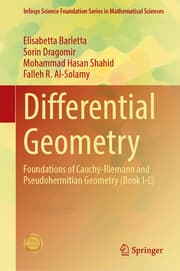
eBook - Foundations of Cauchy-Riemann and Pseudohermitian Geometry (Book I-C), Mathematics and Statistics (R0)
Barletta, Elisabetta/Dragomir, Sorin/Shahid, Mohammad Hasan et al
€148.95
(inklusive MwSt.)
Verfügbarkeit: Lieferbar
Zusatztext
<p class="Corpo" style="tab-stops: 21.25pt 42.5pt 63.75pt 85.0pt 106.25pt 127.5pt 148.75pt 170.0pt 191.25pt 212.5pt 233.75pt 255.0pt 276.25pt 297.5pt 318.75pt 340.0pt 361.25pt 382.5pt 403.75pt 425.0pt 446.25pt 467.5pt;"><span lang="EN-US" style="mso-ansi-language: EN-US;">This book, Differential Geometry: Foundations of Cauchy<em>–</em>Riemann<em> </em>and</span><span lang="EN-US" style="mso-ansi-language: IT;"> </span><span lang="DE" style="mso-ansi-language: DE;">Pseudohermitian Geometry</span><span lang="DE" style="mso-ansi-language: EN-US;"> </span><span lang="EN-US" style="mso-ansi-language: EN-US;">(Book I-C), is the third in a series of four books presenting a choice of topics, among fundamental and more advanced, in Cauchy–Riemann (CR) and pseudohermitian geometry, such as Lewy operators, CR structures and the tangential CR equations, the Levi form, Tanaka–Webster connections, sub-Laplacians, pseudohermitian sectional curvature, and Kohn–Rossi cohomology of the tangential CR complex. Recent results on submanifolds of Hermitian and Sasakian manifolds are presented, from the viewpoint</span><span lang="EN-US" style="mso-ansi-language: IT;"> </span><span lang="EN-US" style="mso-ansi-language: EN-US;">of the geometry of the second fundamental form of an isometric immersion. The book has two souls, those of Complex Analysis </span><em><span lang="DE" style="mso-ansi-language: DE;">versus</span></em><span lang="EN-US" style="mso-ansi-language: EN-US;"> Riemannian geometry, and attempts to fill in the gap among the two. The other three books of the series are:</span></p> <p class="Corpo" style="tab-stops: 21.25pt 36.0pt 42.5pt 63.75pt 85.0pt 106.25pt 127.5pt 148.75pt 170.0pt 191.25pt 212.5pt 233.75pt 255.0pt 276.25pt 297.5pt 318.75pt 340.0pt 361.25pt 382.5pt 403.75pt 425.0pt 446.25pt 467.5pt;"><span style="mso-tab-count: 1;"> </span><span lang="EN-US" style="mso-ansi-language: EN-US;">Differential Geometry: Manifolds, <em>Bundles,</em> Characteristic Classes</span><em><span lang="EN-US" style="mso-ansi-language: NL;"> </span></em><span lang="NL" style="mso-ansi-language: NL;">(Book I-A)</span></p> <p class="Corpo" style="tab-stops: 21.25pt 36.0pt;"><em><span style="mso-tab-count: 1;"> </span></em><span lang="EN-US" style="mso-ansi-language: EN-US;">Differential Geometry: Riemannian Geometry and Isometric Immersions</span><em><span lang="EN-US" style="mso-ansi-language: NL;"> </span></em><span lang="NL" style="mso-ansi-language: NL;">(Book I-B)</span></p> <p class="Corpo" style="tab-stops: 21.25pt 36.0pt;"><em><span style="mso-tab-count: 1;"> </span></em><span lang="EN-US" style="mso-ansi-language: EN-US;">Differential Geometry: </span><span lang="DE" style="mso-ansi-language: DE;">Advanced Topics in Cauchy<em>–</em>Riemann<em> </em>and Pseudohermitian Geometry</span><em><span lang="DE" style="mso-ansi-language: NL;"> </span></em><span lang="NL" style="mso-ansi-language: NL;">(Book I-D)</span></p> <p class="Corpo"><span lang="EN-US" style="mso-fareast-font-family: 'Times New Roman'; border: none; mso-ansi-language: EN-US;">The four books belong to </span><span lang="EN-US" style="mso-ansi-language: EN-US;">an ampler</span><span lang="EN-US" style="mso-fareast-font-family: 'Times New Roman'; border: none; mso-ansi-language: EN-US;"> book project </span><span lang="EN-US" style="mso-ansi-language: EN-US;">“Differential Geometry, Partial Differential Equations, and Mathematical Physics”,</span><span lang="EN-US" style="mso-fareast-font-family: 'Times New Roman'; border: none; mso-ansi-language: EN-US;"> by the same authors</span>,<span lang="EN-US" style="mso-ansi-language: EN-US;"> and aim</span><span lang="EN-US" style="mso-fareast-font-family: 'Times New Roman'; border: none; mso-ansi-language: EN-US;"> to demonstrate how certain portions of </span><span lang="EN-US" style="mso-ansi-language: EN-US;">differential geometry (</span><span lang="EN-US" style="mso-fareast-font-family: 'Times New Roman'; border: none; mso-ansi-language: EN-US;">DG</span><span lang="EN-US" style="mso-ansi-language: EN-US;">)</span><span lang="EN-US" style="mso-fareast-font-family: 'Times New Roman'; border: none; mso-ansi-language: EN-US;"> and the </span>t<span lang="EN-US" style="mso-ansi-language: EN-US;">heory</span><span lang="EN-US" style="mso-fareast-font-family: 'Times New Roman'; border: none; mso-ansi-language: EN-US;"> of </span>p<span lang="EN-US" style="mso-ansi-language: EN-US;">artial differential equations (PDEs)</span><span lang="EN-US" style="mso-fareast-font-family: 'Times New Roman'; border: none; mso-ansi-language: EN-US;"> apply to </span>g<span lang="EN-US" style="mso-ansi-language: EN-US;">eneral relativity and (quantum) gravity theory. </span><span lang="EN-US" style="mso-fareast-font-family: 'Times New Roman'; border: none; mso-ansi-language: EN-US;">These books supply some of the <em style="mso-bidi-font-style: normal;">ad hoc</em> DG </span><span lang="EN-US" style="mso-ansi-language: EN-US;">and PDEs </span><span lang="EN-US" style="mso-fareast-font-family: 'Times New Roman'; border: none; mso-ansi-language: EN-US;">machinery yet do not constitute a comprehensive treatise on DG</span><span lang="EN-US" style="mso-ansi-language: EN-US;"> or PDEs</span><span lang="EN-US" style="mso-fareast-font-family: 'Times New Roman'; border: none; mso-ansi-language: EN-US;">, but rather </span>a<span lang="EN-US" style="mso-ansi-language: EN-US;">uthors</span><span lang="IT" style="mso-ansi-language: IT;">’</span><span lang="EN-US" style="mso-fareast-font-family: 'Times New Roman'; border: none; mso-ansi-language: EN-US;"> choice based on their</span><span lang="EN-US" style="mso-fareast-font-family: 'Times New Roman'; border: none; mso-ansi-language: IT;"> </span><span lang="EN-US" style="mso-fareast-font-family: 'Times New Roman'; border: none; mso-ansi-language: EN-US;">scientific (mathematical and physical) interests. These are centered around the theory of immersions</span><span lang="EN-US" style="mso-ansi-language: EN-US;">—</span><span lang="EN-US" style="mso-fareast-font-family: 'Times New Roman'; border: none; mso-ansi-language: EN-US;">isometric, holomorphic, </span><span lang="EN-US" style="mso-ansi-language: EN-US;">and </span><span lang="EN-US" style="mso-fareast-font-family: 'Times New Roman'; border: none; mso-ansi-language: EN-US;">CR</span><span lang="EN-US" style="mso-ansi-language: EN-US;">—</span><span lang="EN-US" style="mso-fareast-font-family: 'Times New Roman'; border: none; mso-ansi-language: EN-US;">and pseudohermitian geometry, as devised by Sidney Martin Webster for the study of</span><span lang="EN-US" style="mso-ansi-language: EN-US;"> </span><span lang="EN-US" style="mso-fareast-font-family: 'Times New Roman'; border: none; mso-ansi-language: EN-US;">nondegenerate CR structures, themselves a DG manifestation of the tangential CR equations.</span></p>
Autorenportrait
<p><strong>Elisabetta Barletta</strong> is Professor of mathematical analysis at the department of mathematics, computer science, and economy, Universit a degli Studi della Basilicata (Potenza, Italy). She joined the university as Lecturer in 1979 and then became Associate Professor in 2003. She visited several institutes worldwide: Visiting Fellow at the University of Maryland (USA), from 1982 to 1983, to conduct research with Carlos A. Berenstein; Visiting Fellow at Indiana University (USA), from 1987 to 1988, to do research with Eric Bedford; and Visiting Professor at Tohoku University (Japan), in 2003, invited by Seiki Nishikawa. Her research interests include complex analysis of functions of several complex variables, reproducing kernel Hilbert spaces, the geometry of Levi flat Cauchy–Riemann manifolds, and proper holomorphic maps of pseudoconvex domains.</p> <p><strong>Sorin Dragomir</strong> is Professor of mathematical analysis at the Università degli Studi della, Basilicata, Potenza, Italy. He studied mathematics at the Universitatea din Bucure¿ti, Bucharest, under S. Ianu¿, D. Smaranda, I. Colojoar¿, M. Jurchescu, and K. Teleman, and earned his Ph.D. at Stony Brook University, New York, in 1992, under Denson C. Hill. His research interests are in the study of the tangential Cauchy–Riemann (CR) equations, the interplay between the Kählerian geometry of pseudoconvex domains and the pseudohermitian geometry of their boundaries, the impact of subelliptic theory on CR geometry, and the applications of CR geometry to space–time physics. With more than 140 research papers and 4 monographs, his wider interests regard the development and dissemination of both western and eastern mathematical sciences. He is Member of Unione Matematica Italiana, American Mathematical Society, and Mathematical Society of Japan.</p> <p><strong>Mohammad Hasan Shahid </strong>is Former Professor at the department of mathematics, Jamia Millia Islamia (New Delhi, India). He also served in King Abdul Aziz University (Jeddah, Kingdom of Saudi Arabia), as Associate Professor, from 2001 to 2006. He earned his Ph.D. degree from Aligarh Muslim University (Aligarh, India), in 1988. His areas of research are the geometry of CR-submanifolds, Riemannian submersions, and tangent bundles. Author of more than 60 research papers, he has visited several world universities including, but not limited to, the University of Patras (Greece) (from 1997 to 1998) under postdoctoral scholarship from State Scholarship Foundation (Greece); the University of Leeds (England), in 1992, to deliver lectures; Ecole Polytechnique (Paris), in 2015; Universite De Montpellier (France), in 2015; and Universidad De Sevilla (Spain), in 2015. He is Member of the Industrial Mathematical Society and the Indian Association for General Relativity.</p> <p><strong>Falleh R. Al-Solamy </strong>is Professor of differential geometry at King Abdulaziz University (Jeddah, Saudi Arabia). He studied mathematics at King Abdulaziz University and earned his Ph.D. at the University of Wales Swansea (Swansea, UK), in 1998, under Edwin Beggs. His research interests concern the study of the geometry of submanifolds in Riemannian and semi-Riemannian manifolds, Einstein manifolds, and applications of differential geometry in physics. With more than 54 research papers to his credit and coedited 1 book titled, <em>Fixed Point Theory</em>, <em>Variational Analysis, and Optimization,</em> his mathematical orientation over the last 10 years strongly owes to S. Deshmukh (Riyadh, Saudi Arabia), Mohammad Hasan Shahid (New Delhi, India), and V.A. Khan (Aligarh, India). He is Member of the London Mathematical Society, the Institute of Physics, the Saudi Association for Mathematical Sciences, the Tensor Society, the Saudi Computer Society, and the American Mathematical Society.</p>
Weitere Details
Erschienen: 07.07.2025
Umfang: 320 S., 10.39 MB
Sprache: ENG
ISBN/EAN: 9789819650200
Umbreit-Nr.: 7122378
